


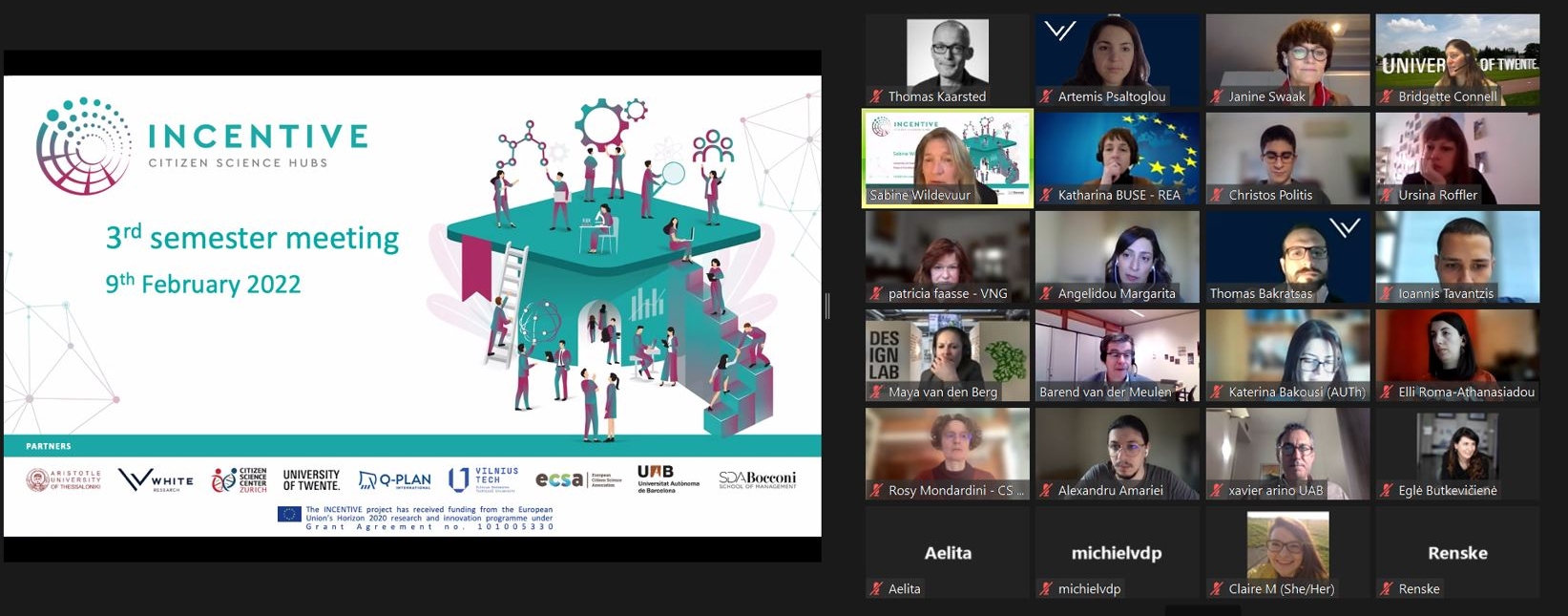
On Wednesday, 9th of February, 2022, the INCENTIVE consortium met for the project’s third consortium meeting, resuming after the Christmas break. As in the previous meetings, due to the ongoing pandemic the meeting was held virtually once again and hosted by the University of Twente (Design Lab), the coordinator of the project. The meeting signaled 1 full year of implementation – the project had kicked off in February 2021 – and the start of a series of core pilot activities for the establishment and operationalisation of Citizen Science Hubs.
However, the event included also a strongly conceptual aspect. During the meeting, two honorary guests were invited to deliver an inspirational speech. On the one hand, prof. Barend van der Meulen from the University of Twente gave a lecture on the challenges of embedding Citizen Science in RPFOs, as well as on realistic measures to be applied to overcome those barriers. On the other hand, Teresa Schäfer, from the Center for Social Innovation, presented her experience on Monitoring and Evaluation frameworks about Citizen Science projects, so as to guide INCENTIVE partners in effectively measuring the success of the project.
Moreover, partners participated in a dedicated interactive working session organised by UT. During the session, partners reflected on the purpose and process of creating the Citizen Science Hubs in each university, by drawing inspirational sketches in the Mural. Many members of the Advisory Board attended the session, sharing their experiences with the younger members and commenting on the results. This helped the consortium shape a common understanding about the next period, which foresees the actual operation of the Hubs.
Another highlight was the introduction of the new Project Officer of INCENTIVE, miss. Katharina Buse. In her speech, the PO reiterated the criticality of engaging citizens and stakeholders in research projects funded by the EU, and the importance of achieving that goal through Citizen Science. She also affirmed the commitment of the Research Executive Agency in helping the INCENTIVE team disseminate the project’s results, and also provided answers to questions posed by partners.
During the meeting, all WP and Task leaders presented in detail the work that they performed since July 2021, the challenges, and the results. Special emphasis was placed on WP2 and WP3, which focus on the consolidation of Citizen Sciences Hubs within the universities and their practical activation through local engagement. UT and UAB, which lead WP2 and 3 respectively, informed the other partners about the achievements so far and what is expected to be accomplished until summer. Partners’ commitment was ensured once again, as the Hubs’ proper function necessitates collective effort.
Of particular importance was the section devoted to the evaluation and assessment of the project’s progress. To that end, Q-Plan introduced an integrated framework that includes various Key Performance Indicators that will help partners measure quantitatively how successful the activities of INCENTIVE will be. SDA Bocconi, as leader of the sustainability WP, together with Q-Plan, outlined the measures taken to guarantee the due exploitation of the project’s results. Afterward, the main dissemination and networking efforts and results (WR and ECSA), were presented to the consortium partners. Attention was paid to the local engagement and synergising actions that the pilot RPFOs perform, and the need to capture and build on these activities.
The meeting ended with the partners planning the next consortium meeting, which is expected to be held physically in Thessaloniki.
Stay tuned, because an exciting third semester is coming, with plenty of pilot activities!
Make sure to subscribe to our newsletter and follow us on our SMAs to receive the latest updates from our project’s next steps!